

Centenary Reflection: Married Love - Marie Stopes
- Olivia Davies

- Apr 30, 2018
- 5 min read
‘The great majority of people in the English speaking countries have no glimmering of knowledge of the supreme human art, the Art of Love’ – Marie Stopes
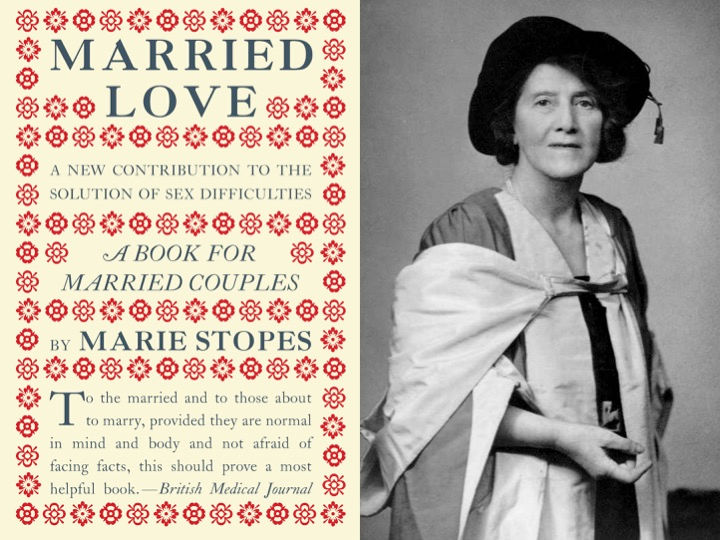
Marie Stopes’ treatise on female contraception and sexual satisfaction was, undoubtedly, pioneering. On its publication in 1918, many of her contemporaries were horrified by, what was to an Edwardian audience, sexually ‘graphic’ and ‘explicit’ content; a guide on how marriages could be ‘saved’ through attention to the woman’s sexual gratification. Deemed obscene, Married Love was banned in America until 1936 through censorship laws. Whilst you’d be hard pushed to find a contemporary audience blush at its content in 2018, there are different reasons why we might hold her to be a controversial feminist. That is, how do her personal beliefs – on eugenics, ethnicity and class – interact with her promotion of female sexual liberation at the start of the twentieth century?
To all intents and purposes, Married Love reads as a ‘how-to’ manual for young chaste Edwardians. There is something of the protective elder sister when it comes to Stopes’ instructional tone, delivered through a variety of, amusing, bourgeois metaphor; ‘only by learning to hold a bow correctly can one draw music from a violin’, she writes in the opening chapter. However, it seems important to recognise a noble element behind Stopes’ desire to publish the book. Despite facing public outrage, Stopes was driven, she reveals, to help others avoid the ‘terrible price’ she felt she paid for ‘sex-ignorance’ during her first marriage. Throughout Married Love, she is demonstrably angry at a cultural situation where ‘large numbers of girls are allowed to marry in complete and cruel ignorance’. This anger and resentment seems to have accurately reflected the British Zeitgeist. It was with the financial support of her second – more sexually liberal – husband, Humphrey Vernon Roe, that her treatise on female sexual satisfaction was published to a very receptive British public in 1918; selling over half a million copies and requiring five editions in its first year of publication.
There are two key points Stopes makes in her book, which offer a pioneering vantage on female sexual rights. Her second chapter, titled ‘Contrariness’ offers a swift revision of a favourite caricature created by the Edwardian man, which depicts women as inherently ‘contrary’, ‘irrational and capricious creatures’. In retaliation to this damaging stereotype, Stopes outlines a coercion process – replicated in many marital beds – where the wife is expected to ‘mold herself to the shape desired by man wherever possible’. This process, she argues, has resulted in a perverse situation where ‘such prudish or careless husbands, content with their own satisfaction, little know the pent-up aching, or even resentment’ felt by their sexually unfulfilled wives. This sexual imbalance, she suggests, is the root (and justified) cause of the resentful wife figure; as cruelly satirised by their ‘selfish’ and ‘ignorant’ husbands in public circles. Nevertheless, Stopes – keen to not isolate the male reader or genuinely convinced of his innocence, I’m not sure – is quick to argue that both genders are victims to social taboos surrounding female sexuality. For, both men and women are affected by the demise of an unhappy marriage. Her message; re-address this sexual imbalance and marital harmony will quickly materialise. Whilst this, perhaps damagingly, optimistic conclusion seems naïve in the extreme; Stopes’ dismantling of the ‘contrary’ wife figure is powerful to read.
The second key point found in Married Love, is Stopes unequivocal statement for a ‘supreme law for husbands’. That is, that ‘each act of union must be tenderly wooed and won, and that no union should ever take place unless the woman also desires it and is made physically ready for it’. For, Stopes argues, the sole intended outcome of martial copulation is – and should be – ‘mutual ecstasy’. There you have it; a clear statement, clearly defining the expectations around marital consent in 1918. A trailblazing and explicit statement, made all the more pertinent when we consider that the marital rape exemption clause was only abolished, in England and Wales, in 1991.
Both of these arguments stem from Stopes’ unambiguous conviction that the female libido should be both recognised and respected as ‘the fundamental pulse’. Throughout Married Love, she consistently dispels the idea that women are mere vessels for male pleasure; this is fundamentally pioneering. It cannot go unnoticed that, in the 100 years since her book was published, Stopes’ position is one that is challenged, through both violent and more subtlety destructive means, in Britain today.
As daughter to Charlotte Carmichael Stopes, whose book British Freewomen (1894), inspired Britain’s suffrage movement, it is clear that women’s rights played a vital role in Marie Stopes’ upbringing. Charlotte was the first woman to get an Arts degree in Scotland, campaigned for Victorian dress reform and spoke publically in campaigns for women’s rights. Along with her second husband, Marie founded the first birth control clinic in Britain; a clear indication that she was prepared to put her views on women’s sexual rights into practice. However, June Rose and Jane Carey argue, along with a number of other academics, that ‘eugenics was central to her birth control vision’; Stopes became a fellow of the Eugenics Society in 1921. It’s impossible not to denigrate the reality that one clinic, created with eugenic ideology in mind, dispensed the so-called ‘Pro-Race’ cervical cap. Therefore, even though Stopes’ promotion of female contraception in Married Love seems to be rooted in the positive belief that women should claim their right to compatible sexuality; it seems that the practice of female contraception was also wrapped up in her bigoted commitment to eugenics. In a later book, Radient Motherhood, Stopes went onto advocate ‘compulsory sterilisation’ for ‘the inferior, the depraved, and the feeble minded’.
Reflecting on Marie Stopes, the woman, forces us to maintain a critical distance on the extent to which we can paint her as a women’s rights advocate. She reminds us of the need to ensure that white, middle-class feminists consistently challenge their own biases and prejudices in order to commit to an intersectional approach to female rights that supports all women.
Returning back, now, to Married Love, what remains convincing is that Stopes’ explicit stance on sexual pleasure and consent would have empowered many an Edwardian female reader and forced some men to question their own actions. This is important. However, what Stopes failed to make clear – or perhaps recognise – is that respect and reciprocal love within a sexual relationship is an end in itself; not a solution for a better marriage. Therefore, it becomes difficult appreciate the Stopes’ overarching confidence that her book should be – and could be – used as a fix-all solution to achieve a perfect union where “the pair will reach from the physical foundations of its bodies to the heavens where its head is crowned with stars”. Nevertheless, 100 years later, we should remember Marie Stopes’ Married Love as a pioneering treatise which brought female sexuality in national dialogue; whilst using our intersectional awareness to avoid revering her as a feminist icon without due criticism.


Comments